
The Part of Our Business We Don't Look At Often. AI Needs to Understand This.

When I had my medical equipment company, change was the one constant we could rely on. New Medicare regulations were an ill-conceived solution to billing fraud. Both the customer and the company were the losers. Our customers needed specialized products and services that saw shrinking margins.
There’s a reason why there are few, if any, durable medical equipment companies left in Florida.
One day I shared an email about Amazon’s customer focus with the team. It sparked an unexpected conversation that changed — this time in a good way — how we handled an everyday customer service transaction. The details aren’t that important here.
What does matter is we uncovered an opportunity to improve something that was already working. It wasn’t broken. The work was completed correctly every time. It just needed to be a lot better.
The Part of Our Business We Don't Look At Often
Most of us don’t spend much time thinking about how our business actually runs. That’s not a criticism. It’s not because we don’t care. We care a lot.
It’s just that things are working well enough until something happens. A customer complains. A visible mistake gets our attention. A regulatory change impacts how we’ve always done something. That’s when we’re forced to stop and figure out what went wrong.
But there’s a different way to think about how your business runs. You don’t have to wait for a problem to arise. That feels reactive, and we rarely do our best thinking under those circumstances. Instead, start with one simple thing you do every day like we did at Quest Mobility Solutions.
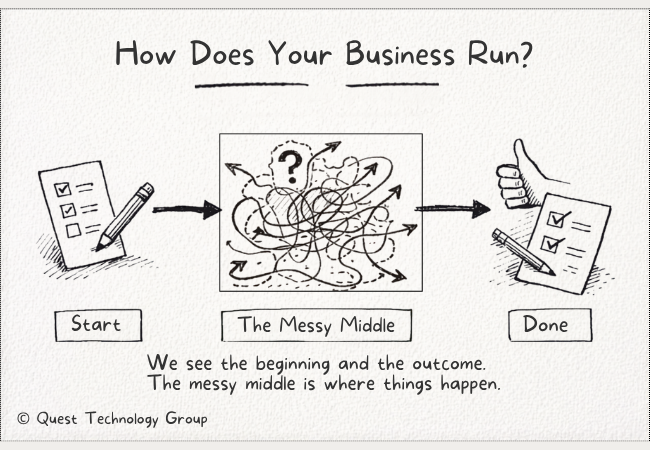
Now take a minute and think about how that one piece of work is actually done. Not just how it starts or how it’s finished. But what happens in the middle. It’s all too common for us to see the beginning and the outcome, but we overlook the messy middle where all the important things happen.
A request is received.
It moves from one person to another.
Someone along the way asks a question.
Responses circulate.
Delays creep in.
A decision is made.
Someone suggests a change.
The loop repeats a few times.
Eventually it’s done.
We see the outcome as straightforward, but it really took a lot of hands and heads in the messy middle to get there. This middle is where your business actually runs.
It also highlights where:
• steps are inconsistent,
• decisions are influenced by who’s involved,
• too many of these steps aren’t written down anywhere and,
• the outcome defaults to “we’ve always done it this way”.
We don’t stop and look at this middle often, not because we’re sloppy, inattentive leaders. It’s because we see movement. The more often we repeat these steps the better everyone becomes at doing them. We polish the imperfect.
How We Can Make the Messy Middle Better
Now imagine that you’re explaining this activity in its simplest steps. If someone was hearing this for the first time, would they understand what’s happening and why?
This is where an unexpected aha pops up. A lot of what is done everyday relies on what people know, experience, human judgment, and unwritten rules.
Here’s something you can do this week to uncover how your business really runs. You’re not going to change anything. No tedious system documentation or workflow mapping involved.
Just pick one piece of work that you or your team does regularly and look at the middle.
Ask yourself:
• What actually happens here?
• Why do we do it this way?
• Where do we rely on human judgment to make decisions?
• Where would a new team member get stuck?
• What happens if a person in the loop is no longer there?
• What happens if a tool we rely on stops working?
You might find a well-organized, reliable start/middle/end. Or you might discover parts of your business that are unclear legacies.
What New Technology Really Needs To Do Its Best Work
There’s a lot of talk right now about what the newest technology can do for us. There’s a lot less conversation about understanding the job this technology is being asked to do.
Just like a new team member, these tools rely on clarity, purpose, and consistency. The companies that take the time to first understand and explain how their work is done will gain the most from these tools. If a human isn't sure what to do, AI certainly won't get it right.
The Bottom Line
The next time you tackle one of the everyday things that effortlessly moves from start to finish, take a minute and look at what happens in between. This isn’t about changing anything. It’s simply seeing parts of our business that most of us don’t take time to look at.
Once you see it in one place, you can’t resist the urge to look for it everywhere. The messy middle is where your business runs.
How Work Happens Here
Before you decide what to do with AI, see the work people do every day. What happens between start and end is the important middle.
Then decide what's right for your company.

Explore How Work Happens Here
 Linda Rolf is a lifelong curious learner who believes a knowledge-first approach builds valuable, lasting client relationships.
 She loves discovering the unexpected connections among technology, data, information, people and process. For more than four decades, Linda and Quest Technology Group have been their clients' trusted advisor and strategic partner.
Tags: Business Strategy