
Create AI Policies That Reduce Shadow AI and Encourage Innovation
I have to confess that structure flips my anxiety switch on. My brain curls up and takes a nap. What-if thinking freezes. That probably sounds counterintuitive because I write about and advocate for policies and procedures a lot.
The introduction of AI into our day-to-day business, whether we invited it in or not, has added governance to our vocabulary. If there is one word that crushes my creative soul, governance is it.
Here's where the governance messaging fails.
Guardrails absolutely do matter – a lot. The attorneys, tech professionals, and security experts who continually beat the governance drum aren’t wrong. AI adopted without responsible scaffolding threatens the security, integrity, and future of our business.
Technology advances aren’t new. As far back as recorded history takes us, amazing innovations have transformed our lives. More recent than fire and the round wheel, we’ve seen typewriters and carbon paper replaced by Word.
Excel and accounting software made ink and pen ledgers obsolete.
GPS apps get us where we want to go without unfolding a paper map.
The list is long and continually growing. All these technologies give us more freedom to build the optimized life we imagine for ourselves.
AI Isn’t Just Another Handy Productivity App
AI is a different form of technology enabler. Its strategic possibilities have less to do with technology and more about the impacts on human thinking.
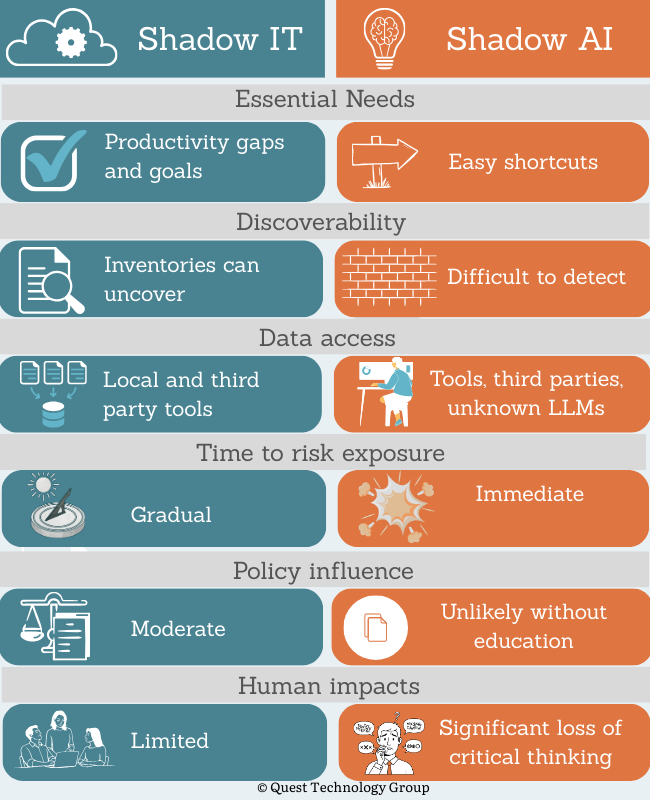
Shadow IT has been a long-time problem in just about every company. Now we’ve added shadow AI to the risk deck. Both happen when employees sidestep the established approval process and bring unvetted tech tools into your company’s workflows.
The costs and risks with this undisciplined practice are too high to ignore. (So yes, I do support policies and procedures at the right time. We’ll get there in a minute.)
How does this employee-driven technology landfill happen? The most common possibilities are a combination of these:
No time to research it. No budget. No clear direction from leadership. No idea what it’s supposed to do. No interest. The desire to defend the long-standing divide between business needs and technology features.
What the New Innovative Company Leaders Do Differently
Do you know how many people in your company are using one or more AI tools for some part of their work? Probably more than you realize.
These are the folks you want to spend time with, not to penalize them and stifle their exploration. Instead, you want to understand what they’re using AI for and what they’re learning. These are your creative thinking leaders. More importantly, you need to find both the curious adopters as well as the lazy shortcut seekers. The reasons are obvious.
Smart leaders know that AI is a powerful asset when it’s used responsibly. Instead of rigid policies that squash curiosity and limit your company’s competitive opportunities, you become the new thinking catalyst. Why does this matter? Because innovation happens when people slow down and think, not when they work faster.
What are your company’s big goals this year? Employees will do their most effective work when they have a clear understanding of what leadership thinks and expects.
Communicate simply and regularly. Ditch the company meetings, slide decks, and time-wasting puffery. A visual dashboard or short summary are all you need to deliver the message everyone is eager to hear. This was our goal. This is what we accomplished. This is what we learned. This is where we’re going next.
Reinforce that business goals come before technology buying. Throwing more tools at an existing problem doesn't fix the flaws. It exposes them. Create a simple discovery playbook that prevents reactive, ad hoc buying decisions. People create strategy and solve problems. Technology helps execute the plan.
Ensure your strategy is the cornerstone for AI conversations. Your company's goals are nuanced, situational, and changeable. When AI is unclear about context and purpose, it will invent a strategy for you. Its not a hallucination, merely an anchor based on generic best practices and learned norms.
Always, always value and encourage human thinking over AI confidence. Establish the framework that distinguishes between curiosity and acceptance.
Curiosity without blind adoption
Acceptance with guardrails
Savvy Leaders Show by Example
We can all agree that unfettered use of any tech tool without guardrails is an irresponsible decision. Employees appreciate and respect boundaries when they understand why they’re necessary.
Lead by example to remind everyone that “I’m learning too.” Show employees how you’re using AI. Share actual examples of your prompts and answers. What were you trying to accomplish? What was spot-on? Where did you challenge AI and why? What did you learn? What will you do differently the next time?
Explain how an AI conversation improved your thinking. Show your prompt and the chat thread. For every answer that AI handed you, what did you do next to challenge your thinking? How did AI sharpen, not replace, your strategic thinking? How did AI encourage you to change your approach?
Invite employees to frame your question in their own words. You'll discover how well they understand your goals. Most likely their words will be different than yours and that's valuable. Knowing how to communicate clearly is a skill we all can continually polish.
Ask “what is one big problem we should concentrate on now?” What happens when we solve it? How does it align with our company’s goals? What happens if we don’t solve it?
This. Remind everyone often that human thinking and informed judgment are irreplaceable.
How Work Happens Here
Before you decide what to do with AI, see the work people do every day. What happens between start and end is the important middle.
Then decide what's right for your company.

Explore How Work Happens Here
 Linda Rolf is a lifelong curious learner who believes a knowledge-first approach builds valuable, lasting client relationships.
 She loves discovering the unexpected connections among technology, data, information, people and process. For more than four decades, Linda and Quest Technology Group have been their clients' trusted advisor and strategic partner.
Tags: AI