
10 Breakup Questions to Ask Before You Buy SaaS Services, Software, and Services
10 Breakup Questions to Ask Before You Buy SaaS Services, Software, and Services
Neil Sedaka got it right when he sang the words "breaking up is hard to do." Have your ever been forced to pay for a product or service that you wish you had never purchased in the first place?
Most of us have been faced with buyer's remorse at one time or another. What seemed like — or was — the right decision at the time becomes regret. No escape payments only make the decision feel worse.
Relationships Don't Last Forever
Long-term commitments are common with SaaS, software, and technology providers. Quest has always avoided this practice for one simple reason. We believe clients deserve the right to decide who they do business with.
Sometimes, what starts as a mutually beneficial relationship changes. Clients grow, pivot, are acquired, or close their doors. Other times, it’s a more human misalignment.
Regardless of the reason, when we can no longer serve that client, the right thing to do is to let them move on. Sure, it’s a cash flow hit, but client revenue isn’t what makes a relationship work. If we can’t provide what they need, then we can’t expect them to pay us. It’s really that simple.
We found ourselves locked into a useless vendor agreement. Each month that we were forced to pay for a service we no longer needed was wasteful. We disliked that company a little bit more with each payment.
What that vendor exchanged for recurring revenue was reputational damage. There are hundreds of negative reviews on Trustpilot about this company and its rigid termination policy. For each customer that hands them unearned revenue, it’s likely they lose far more potential new customers.
Ask Questions Before You Commit to a Vendor
While none of us can predict the future, there are questions we can ask a provider to reduce decision uncertainty. Software and services are increasingly complex, and the boundaries between third parties are less clear. It's the buyer's job to slow down and make responsible decisions.
Here are 10 breakup questions that will help you decide if this is the company you want to do business with.
Q1. If we decided to leave a year from now, what would it take to export all of the work we’ve created?
Q2. If we exported all of our data, would another application or service be able to reconstruct and use it?
Listen carefully to what the salesperson is saying. If they say yes, ask them to show you actual examples of this working.
Q3. Ask yourself and your team what value, not just what data, this application is collecting.
Tools like CRMs, document libraries, accounting, support systems, build knowledge data as well as transactional records. Exporting raw data without the context to give it meaning might be less useful than expected.
Q4. Who owns the data?
Find the contractual wording buried in the Terms and Conditions that clearly defines where ownership begins and ends. AI has muddied the waters so the more explicit the language the better. Courts are being challenged every day to clarity ownership, usage, and risks.
Q5. How is our data shared with third parties?
Read the Terms and Conditions. Providers that are staying current will include their data sharing policies. I’ve found more than a few established SaaS providers that are silent on this policy. That’s a troubling practice.
Ask the vendor for a list of all third parties that have access to your data. As integration among software applications becomes more common, your data footprint will expand without your knowledge or explicit approval.
It’s rare to find a vendor that discloses their third-party partnerships. They’re continually changing, and they impact the proprietary nature of the software.
Q6. How is our data used for AI model training?
Ask what options you have to protect your confidential and proprietary data. Insist on this in writing. It’s safe to assume that this policy will continually change so reading the Terms and Conditions updates is a tedious requirement.
Q7. How integrated is this software with proprietary workflows and APIs?
When applications rely on proprietary technologies, your data becomes less portable to another application or service.
Q8. If our business changed and your service was no longer needed, could we terminate at any time?
Get this in writing. Onboarding is designed to be easy. Leaving is built on a foundation of friction. Vendor lock-in is baked into their model.
Q9. If our business is sold, can we terminate the agreement?
It’s interesting that a vendor acquisition means you’re doing business with a new vendor you never chose. When a company is acquired, does this same relationship logic apply?
Q10. What is the written policy on automatic renewals?
Will you explain the steps we need to take to ensure we have control over our renewal. This is where the FTC tried to step in and protect businesses. So far, that effort has stalled.
The Simple Breakup Reality
Most decisions focus on how fast and painlessly you can start. Providers know this and build their sales and onboarding around convenience. Very few decisions consider how hard it will be to leave.
The Bottom Line
Projecting your company’s cash flow makes a fixed-term customer commitment attractive. I get it.
Here’s one way to show customer thinking when this model is best for your company. Provide something of real value that is hard for your customer to lose if they terminate. Give them the option to pay a premium termination-only rate for your services if they want to leave midterm. Require 30 days’ notice to make the switch. Condition this on the client having a sound payment history and no outstanding balance.
The trust this creates at the onset is invaluable. The right customers appreciate having the freedom to choose. They feel like you understand and care about their business. Your relationship is built on meaningful service, not on a customer ATM mindset.
Learning Circles Help Leaders Make Calmer Technology Decisions
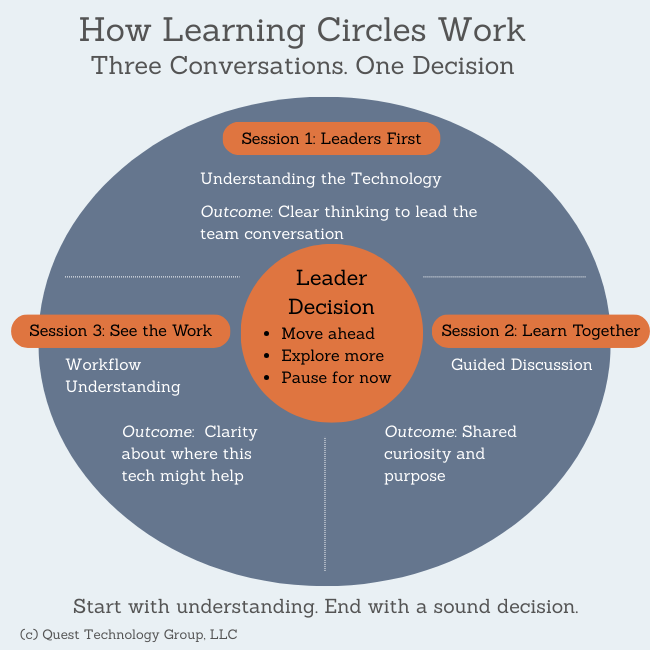
Explore technology with your team before you commit. Learn together first. Then decide what to do next.
Explore the Learning Circles
 Linda Rolf is a lifelong curious learner who believes a knowledge-first approach builds valuable, lasting client relationships.
 She loves discovering the unexpected connections among technology, data, information, people and process. For more than four decades, Linda and Quest Technology Group have been their clients' trusted advisor and strategic partner.
Tags: Business Strategy