
What Happens When We Trust Simplicity
What Happens When We Trust Simplicity
I won't pretend that I can predict the future, but I'm trusting the tea leaves on this one. Last week Claude announced two new additions to its product offerings — Claude for Small Business and Claude for Legal.
At first glance this sounds like normal software positioning. Companies have always packaged products for specific industries. But I think these announcements reveal something much bigger that we should think about.
AI is quietly moving from conversation tool to operational participant.
A lot of us still use AI transactionally — ask it to help write something, summarize a meeting, research a topic, or think through a problem. There's nothing wrong with starting there. But the market is moving rapidly toward something very different, and these new domain-specific offerings are a signal of that shift.
The message behind Claude for Legal and Claude for Small Business isn't simply here's AI for your industry. It's let AI participate more deeply in how your business operates every day. That changes our relationship entirely.
It's More Than Just Doing a Task
Imagine this. One of your team comes to you with an AI use case that (finally) makes sense for your business. They've figured out how to get AI to handle your invoicing end to end. It pulls data from your project tracking system, calculates the billable work, feeds the details to QuickBooks for invoicing, and sends the invoice to your client. What used to take an hour now largely runs on its own. You approve it. It works. AI is making sense.
What you're not seeing is everything that had to be true for that to work. Your employee made dozens of small decisions along the way — what apps to connect, what to trust the AI tool to handle, what data access it needed, where a human still needed to review something.
They knew what an accurate invoice looked like and quietly adjusted when it wasn't right. They built an AI-assisted workflow that works, in part, because they understand your business and were paying attention to the messy middle pieces. That human understanding is now embedded in the system itself.
Six months later, a change happens because that's how business operates.
QuickBooks updates its platform.
The AI vendor changes how their integrations work.
Pricing shifts.
You switch to another project tracking tool.
Your employee who set up this automation leaves your company.
The invoices stop going out. You only find out when your financial folks ask why revenues are tanking.
That's not a technology failure. That's what it looks like when the human context behind how work gets done disappears along with the person who held it.
How AI Tools Do Their Best Work
Here's what makes this moment different from the vendor dependencies you've managed before. Traditional software mostly delivers value inside the application itself. AI-integrated systems become more valuable the more connected they become.
That means every integration your company builds is also a dependency your company inherits.
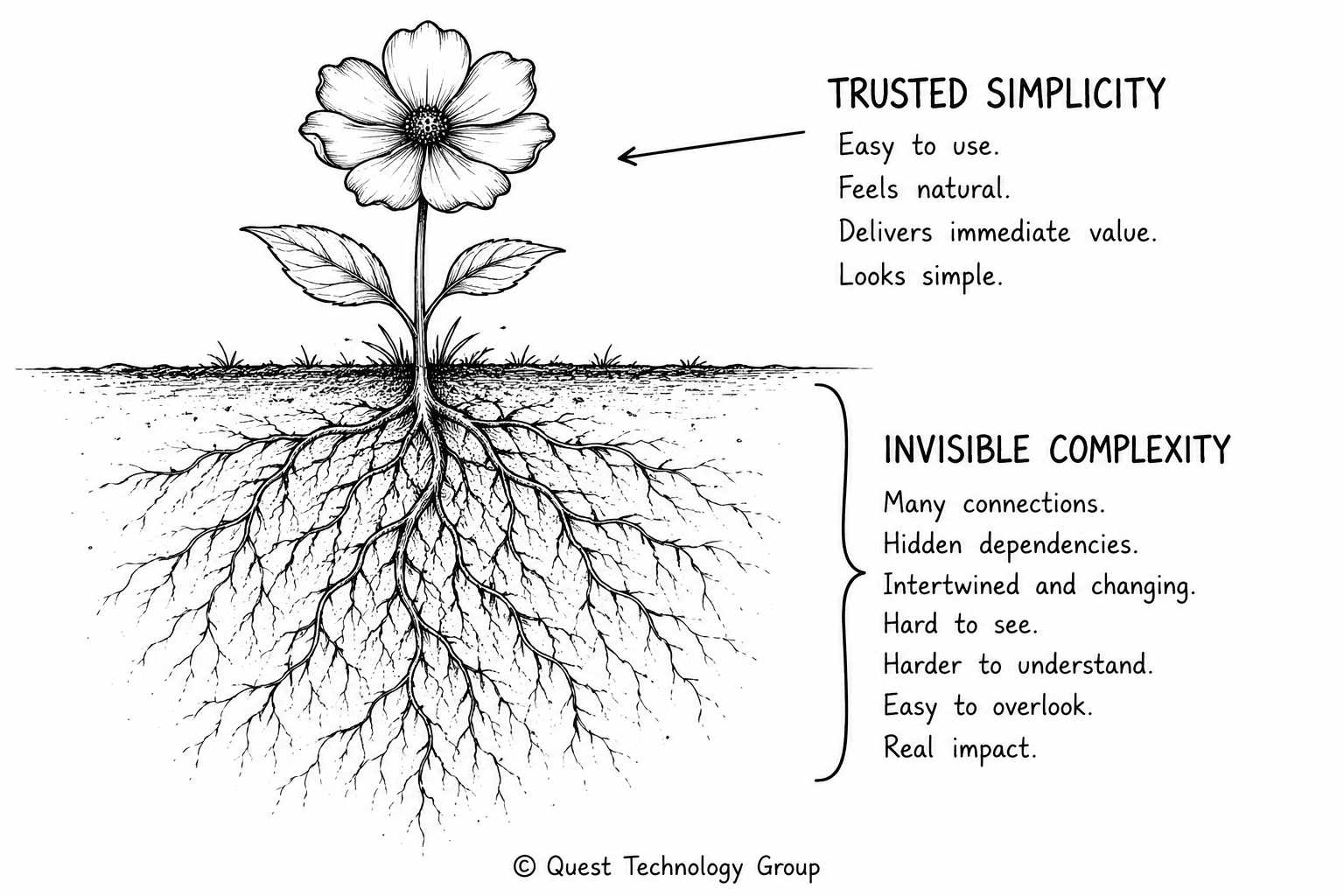
You now have unseen multiple connections, layered on each other, each one shaped by someone's judgment about how your business works. These are rarely documented because setting them up is quick and easy. No one is assigned to continually monitor when something changes with one of these vendors.
And the harder truth: the more efficient the automation becomes, the less visible the dependency chain becomes underneath it.
What I Can't Help Thinking About
If you're feeling like this, you're not alone. We know AI is valuable. We know our team should be exploring it. But complexity seems to be growing faster than our understanding of what's actually being built. That feeling is worth paying attention to because it's accurate.
The answer isn't to slow down AI adoption. It's to start with a clear picture of how our work is done every day now. Then as AI becomes more integrated, we will have the foundation that shows how this work is moving differently.
(1) AI is starting to feel more trustworthy because the experience feels simple.
If something feels easy and done-for-you, we can stop asking the important questions:
What does this connect to?
What have we changed about our day-to-day operations?
What dependencies did we invite into our business?
Who understands this workflow?
What happens if it breaks?
How will we know if it's not working any longer?
(2) The packaging says, “We understand your business, and we've just simplified it for you.”
The reality says, “You're about to integrate AI and a bunch of vendor dependencies deeper into your business.”
Growing a business is demanding. The pressure to do more quicker, faster, and better is relentless. It does nothing to ease the anxiety. Who doesn't welcome simplicity? That's the promise of AI tools — to create a sense of movement without complexity.
(3) What we're really experiencing is a new level of abstraction wrapped inside convenience.
Buttons do the integration work.
Clear interfaces hide the workflow steps.
Dependencies disappear behind automations. How work is done observations are replaced by AI outputs.
Understanding how work moves every day matters as much as it ever did.
We just don't see it.
That's packaging, not irreplaceable domain expertise. Vendors are selling us relief from complexity while we inherit dependencies.
(4) Find out what you already have.
Before you fall into the hurry up and do something trap, ask your team this simple question: what have we started doing differently in the last eighteen months because of AI, and what is it connected to?
You're not auditing anyone. You're just getting a picture of how work is actually happening now. Most leaders are surprised by what's already running, and how few people fully understand it.
(5) Make vendor dependencies part of the decision.
This is just a conversation. You need one person — whether that's an internal team member, your IT provider, or a trusted advisor — who can tell you how these connections are configured and why they were built the way they were. This isn't to manage technology and people. It's to make sure the implementation support doesn't disappear when people do.
(6) Add one question before you say yes.
When someone brings you a new AI tool or capability, you're probably asking what it does and what it costs. Add a third: what does this connect to, and what happens to us if that changes?
You don't need the technical answer. You need to know that someone has thought about it. This creates the foundation everyone needs for their AI thinking.
(7) None of this means you have to become a technology expert.
It simply builds on the same instinct you already apply to any critical operational decision. What are the key relationships, where does the institutional knowledge live, who understands how things really work around here.
AI is creating new versions of those dependencies. They're just not visible, and that's where simplicity can be misleading.
The Bottom Line
I don't think our biggest long-term challenge with AI will be the technology itself. It's likely the combination of trusted simplicity and invisible complexity.
AI is starting to feel more trustworthy because the experience feels simple. The further we move from complexity to simplicity, the less curious we become.
The companies that navigate this well long-term won't necessarily be the ones that moved the fastest. They'll be the ones that still understand and stay curious about how their business works after these integrations run deep.
How Work Happens Here
Before you decide what to do with AI, see the work people do every day. What happens between start and end is the important middle.
Then decide what's right for your company.

Explore How Work Happens Here
 Linda Rolf is a lifelong curious learner who believes a knowledge-first approach builds valuable, lasting client relationships.
 She loves discovering the unexpected connections among technology, data, information, people and process. For more than four decades, Linda and Quest Technology Group have been their clients' trusted advisor and strategic partner.
Tags: AI