
We Just Wanted to Convert a Word Doc to a Blog Post
We Ended Up With an AI Tool Decision We Hadn't Expected

Where this started
I dread creating a blog page from a Word doc. It's the tedious repetition that I struggle to tackle. And so like any normal person who dreads doing something, I simply avoided it.
Our typical content flow looks like:
What we noticed
Each single Word doc does a lot of work. It's a practical place to start because it moves from the first messy thinking draft to the final version. It's what comes after Word that was getting in the way. The problem is each publishing platform deals with Word's embedded formatting differently. That means copy -> paste -> cleanup -> publish. More tedious work that few of us would want to do.
I say "few" because we had a wonderful team member Sonya who loved nothing more than diving into work just like this. She was our go-to for the tedious that no one wanted to do, and she was thrilled. Sonya was our pre-AI gem.
What we almost did
The easiest solution was to keep doing what we've always done. It seems easier to continue a flawed process than to slow down enough to consider a better one. This time it wasn't an option.
What we decided to do
There are several reasons we decided to find a better way around this problem. We enjoy writing. It feeds our curiosity. Half the time we're simply trying to figure things out ourselves. We hate seeing finished articles stuck in Word docs.
We started wondering whether all the work we put into writing deserved a better way to get out into the world. To be honest, we felt like we owed it to ourselves to end the dread and procrastination. We don't know what the future of search or AI will look like. But we do know this. We enjoy writing, and people still want to hear from people. It felt like the way we shared those thoughts needed to change too.
When we took the time to think about all of these significant changes, it was clear that doing what we've always done wasn't the right answer. So, we turned to Claude with one small assignment: convert the Word doc into a webpage. We gave Claude a description of our techical framework, the Word doc, an existing page to use as the template, what to update and what not to touch from the template, the results we expected, and watched it execute. We verified that the page's formatting and content were correct.
We had achieved a milestone.
What we decided not to do
Being vendor-neutral has always been an important part of our technology decisions, both for our company and our clients. Over-dependence on any vendor, product or service is a short-term decision that can get in the way of long-term success.
We regularly work with both Claude and ChatGPT because each has its strengths. Making an AI tool decision shouldn't be pick one or the other. With the models evolving so quickly, they are continually changing places in the jobs they do well. So, we decided to give ChatGPT the same assignment Claude had successfully completed.
What we learned
We started by giving ChatGPT the same prompt and input files that Claude was using. We even told ChatGPT that this was what Claude was doing.
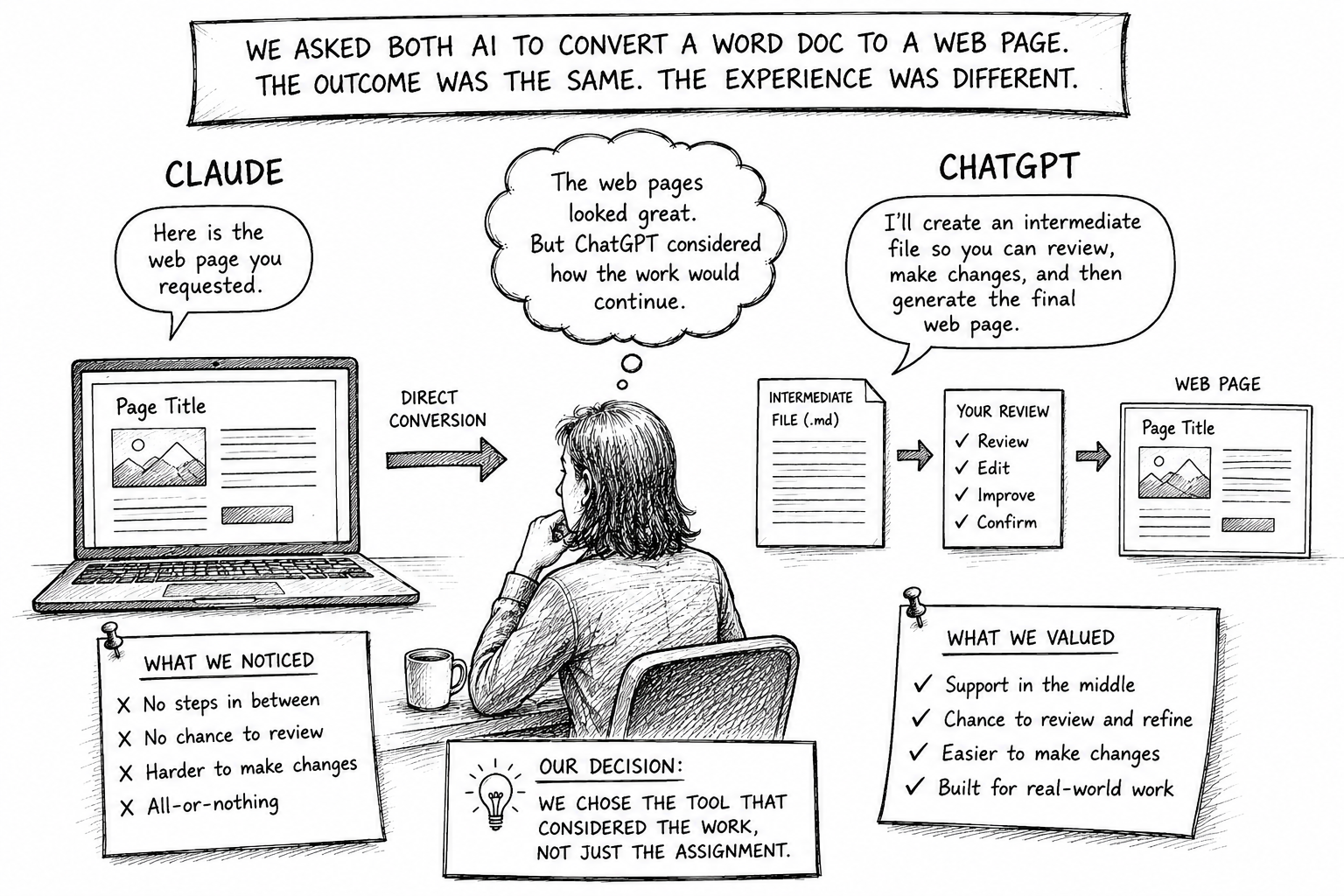
ChatGPT accepted the assignment and delivered a completed webpage. We verified the output and declared it good. But ChatGPT didn't just do what we asked and call it a day. It offered another way of processing our request. Claude simply followed the instructions and produced the final page in one processing step. ChatGPT said that, while it was technically okay, incremental steps might be better. It went on to explain its reasoning with each step described. It was a smart approach because it gave us the opportunity along the way to make changes.
It started by generating the page name, doing the boring SEO work, adding the schema, and updating all the image names. Then it asked what we wanted to change or correct. Then it moved on to building the page body from the Word doc. It handled the formatting and even suggested a change that we could approve or not. Finally, it caught a typo and asked if we wanted it to be corrected. Claude didn't catch the typo.
What surprised us
Both Claude and ChatGPT produced the webpage we requested (including Claude's version with the typo). What surprised us was how differently these tools behaved. It wasn't just that ChatGPT caught a typo. It's that it seemed to think beyond the assignment. It acted less like someone checking off a to-do task and more like someone thinking about how we would work with the output later.
Claude performed like a new intern. It did what it was told to do and nothing more. ChatGPT, on the other hand. acted like a senior developer on our team. It asked questions. It understood the purpose of the task, and then it offered a more robust, mature design.
It's natural to focus on the outcome with our AI instructions. What this taught us is it's what happens in the middle between start and end that make a huge difference. This is surprisingly like what we talk about with How Work Happens Here -- noticing the work that people do every day between start and end.AI tools aren't human, but they do have behaviors that matter.
It's no surprise that we've decided to use ChatGPT for this Word doc to blog post work. There are more tasks to be added, and the framework is already in place to fit them in without disrupting what already works.
The Work Before AI
Before you decide what to do with AI, see the work people do every day. What happens between start and end is the important middle.
Then decide what's right for your company.

Explore The Work Before AI
 Linda Rolf is a lifelong curious learner who believes sharing her knowledge, experience, and lessons learned builds valuable, lasting client relationships.
 She loves discovering the unexpected connections among technology, business, and people. For more than four decades, Linda and Quest Technology Group have worked beside their clients, helping technology serve theirbusiness, not the other way around.