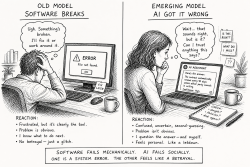
Does Our Provider's Change Matter For Us?
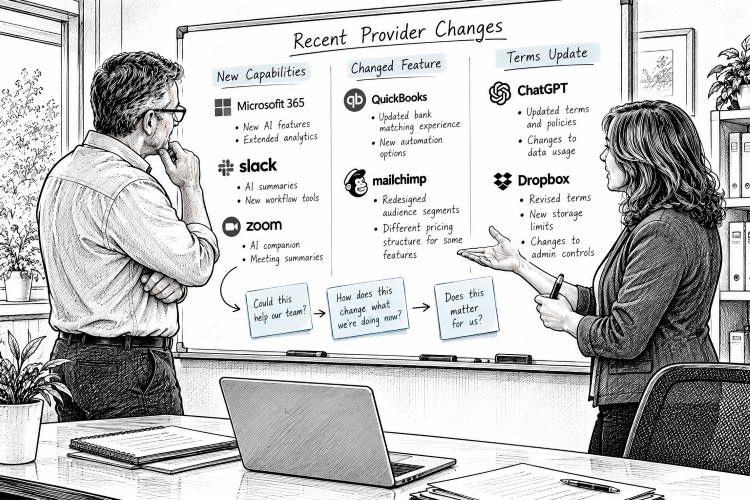
Is the Technology Service You Chose Still the One Your Business Is Using Today?
But that wasn't the end of your decision.
Over time your provider continued to change the product. They added new capabilities. Other products were able to connect to it. People found new ways to use what they already had. None of these changes required a decision. They happened while people were doing their every day work.
Your company decided that Microsoft 365 offered what your business needed. You use Microsoft 365 every day.
Microsoft has terms that govern its services.
But two years later, is the 365 product your purchased then the one that your teams are using every day now?

Imagine that an employee opens Outlook Monday morning and sees a new Copilot icon. It sounds interesting so she enables this feature. No one bought a new product. It's still 365. No one approved this new technology. Microsoft didn't necessarily changes its terms Monday morning.
But something changed. Does it matter?
But something changed. Does it matter?
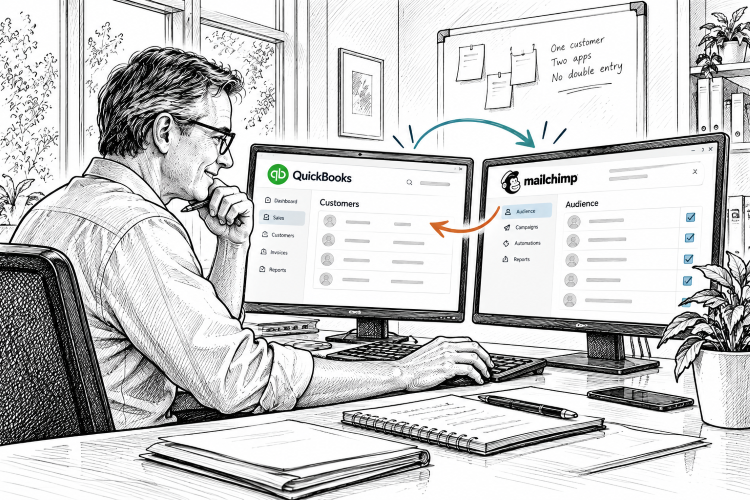
Your team connects a service to QuickBooks because it eliminates the need to enter the same information twice. This new integration works just like it should, and everyone is pleased.
But now your company's information is moving differently than it was when you originally decided to use both of these products independently.
Did this integration change anything that matters?
But now your company's information is moving differently than it was when you originally decided to use both of these products independently.
Did this integration change anything that matters?
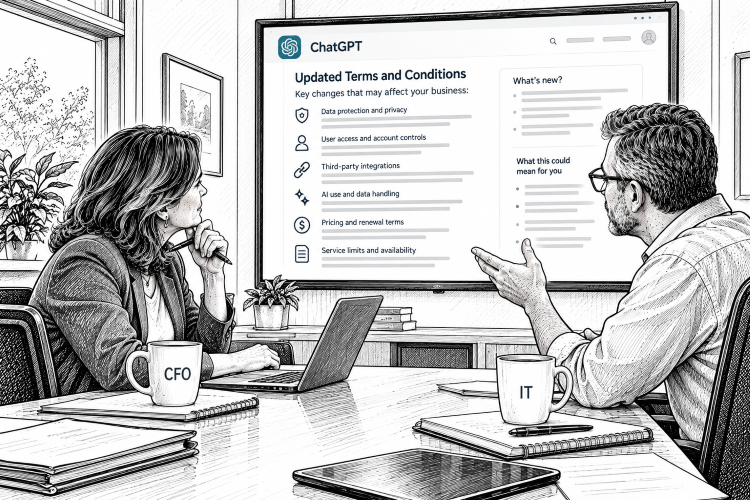
One of your providers changes their terms of service. Most of the changes don't have anything to do with you. But there is one statement that changes how AI uses the information it has access to. That sounds important, but you don't use that feature right now.
Maybe nothing changes for your business.
Maybe nothing changes for your business.
None of these moments looks particularly important by itself. But each one changed something about the relationship between your business and your technology provider.
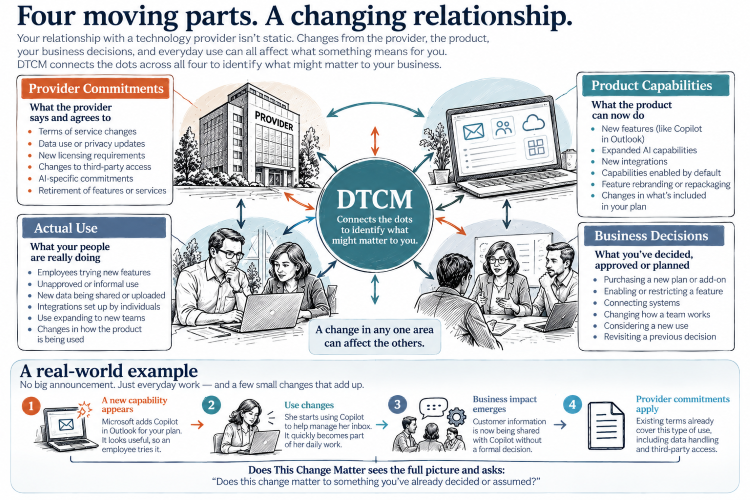
Your relationship with a technology provider doesn't stand still.
Maybe your provider changes what it promised to do.
Maybe the product capabilities change.
Maybe you've decided how your business uses it changes.
Maybe people use the product differently.
Those changes don't necessarily happen together. That makes the connections between the changes easy to miss because they often don't move together.
Maybe your provider changes what it promised to do.
Maybe the product capabilities change.
Maybe you've decided how your business uses it changes.
Maybe people use the product differently.
Those changes don't necessarily happen together. That makes the connections between the changes easy to miss because they often don't move together.
Where We Start
How do you make sense of all these changes?
You probably already receive plenty of information from your technology providers. New features, updated terms, changes to pricing, new ways to connect services. Some of it matters to your business. Much of it doesn't.
The harder part is knowing which changes affect the decisions you've already made and the ways your people use those services today.
That's what Does This Change Matter is here to help you understand.
We begin by getting to know the technology your business relies on, how people use it, and the decisions you've made along the way. We pay attention to what your providers are changing, including their commitments and what their products can do.
As we learn more about your business, we can connect those pieces. When something changes, we look at what we already know and ask whether it matters to you.
How We Continue
What happens when something changes?
Something changed.
A provider introduces a new capability, changes a commitment, or we learn that your people are using a service differently. Does it matter to your business?
We consider that change alongside what we know about how your business works, the decisions you've made, and the people or information involved. What do we know now?
Sometimes there's something that needs attention. Sometimes an earlier decision deserves another look. Sometimes there's a new possibility worth exploring. And sometimes nothing needs to change.
When something does deserve attention, we'll help identify who belongs in the conversation and what needs to be decided next. That might be someone on your team, your IT provider, your accountant, your attorney, or Quest.
What You Experience
How do you get to know our business?
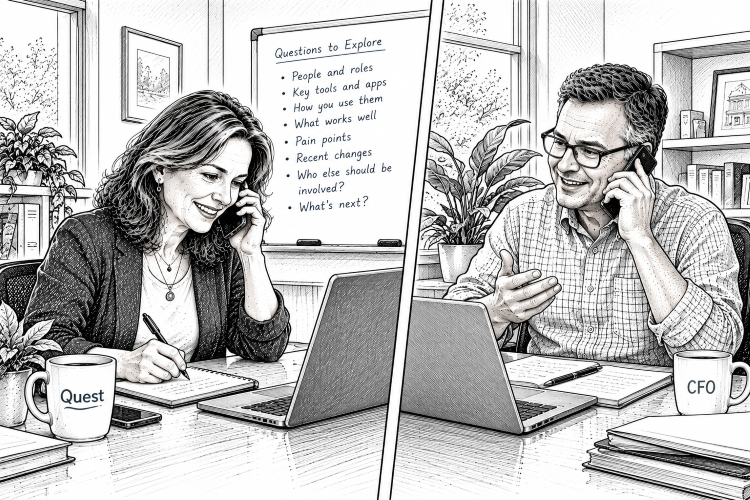
We start with a conversation about the technology your business relies on every day.
What services are important to your work? How are people using them? What other services do they connect with? Are there decisions you've already made about how they should be used?
You don't need to have all the answers. This isn't a test. We'll begin with what you know and follow the questions that come up. From there, we'll look at what your providers offer and the commitments they've made, connecting that information with what we've learned about your business.
What happens as things change?
Our first conversation is just the beginning. You might tell us that your team has started using a new feature, connected two services, or changed how something gets done. We might notice that a provider has introduced a capability or changed a commitment that deserves another look.
Each conversation and discovery adds to what we know about your business. Over time, we build a clearer picture of how your technology, everyday work, and business decisions fit together. That gives us more context for recognizing which changes matter to you.
What will you need from us?
You don't need to document every application, feature, or technology decision before we can begin. We'll start with a few services that matter to your business and build from there.
As things change, we'll occasionally have questions. You may have something new to tell us, too. The more we understand about how your business uses technology, the more clearly we can recognize which changes matter to you.
Getting to know each other
You'll have someone at Quest who gets to know your business and how technology fits into the work you do. We'll begin with a conversation about the services you rely on and the decisions you've made about using them. You'll help us understand your business, and we'll share what we're learning about your technology providers.
As we get to know each other, sharing something useful can be as simple as someone on your team saying:
"Oh, by the way, we're doing this differently now. I thought you might want to know about this."
or Quest sharing:
"We noticed something that your provider introduced. Is anyone on your team using this yet?"
That little bit of information might help us connect something neither of us would have noticed on our own. Over time, we'll both become better at recognizing which changes deserve another look.
Let's Get Started
We'll start with a conversation.
What You Pay Each Month
No long-term commitment.
Cancel any time (but we hope you'll give us a chance to work together)
$95 / mo.